
Season’s greetings and best wishes for 2022
|
RP: RECEIVED PRONUNCIATION
|
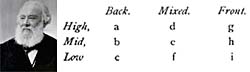
Alexander Melville Bell’s vowel model
150th Anniversary September 2017
|
|
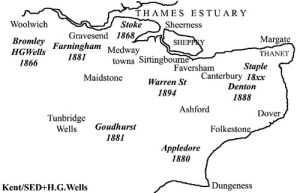 Sound change in 19th c. Kent Sound change in 19th c. Kent
The sound changes concern one consonant /r/, and nine vowels (FACE, PRICE, TRAP, STRUT, THOUGHT, GOAT, MOUTH, LOT and BATH) …. continue
|
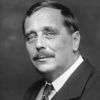 H G Wells (1866-1946) had acquired four out of six 19th century sound changes in Kent and his accent was thus just halfway to Estuary English (read more, PDF or slideshow) H G Wells (1866-1946) had acquired four out of six 19th century sound changes in Kent and his accent was thus just halfway to Estuary English (read more, PDF or slideshow)
|
Regional Accents
Dialects and accents, standard accents, regional differences and sound change … Continue reading
Southern British English (SBE)
Estuary English before Rosewarne, Southern British English, The RP accent, How many speak RP? … Continue reading
|
Home Counties SBE vowel formants
More home counties data, confirming the THOUGHT, LOT, STRUT and GOOSE tendencies already seen … Continue reading
|
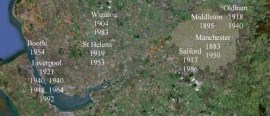
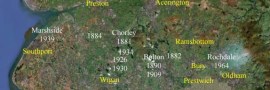
Rhoticity in Lancashire
|
§
|
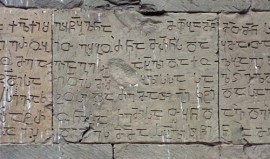
Tbilisi 1990
Posted 4 September 2013
Lund linguistics excursion
|
Posted 1 Dec 2012
Maikop 1992
The 6th Colloquium of the Societas Caucasologica Europaea, Maikop, Republic of Adygeia, June, 1992.
Read here
The Societas Caucasologica Europaea
Read here
|
Correlation and causality
Acacias favour tone languages?
Promiscuity fosters sonorance?
High altitudes stimulate ejectives?
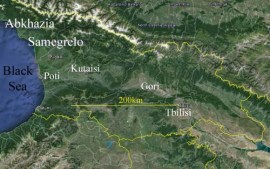 Lowland Kartvelian ejectives in Georgia. Lowland Kartvelian ejectives in Georgia.
Posted 17 August 2013
Postscript added 8 Sep 2013
Read here
|
Sound recording technology
Posted 25 April 2013
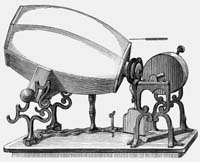 The first apparatus for recording and playing back sound was Thomas Edison’s Phonograph. Before that, Édouard-Léon Scott de Martinville had perfected a method for making graphic records of sound waveforms, patented in 1857 as the Phonautograph ... Read more … The first apparatus for recording and playing back sound was Thomas Edison’s Phonograph. Before that, Édouard-Léon Scott de Martinville had perfected a method for making graphic records of sound waveforms, patented in 1857 as the Phonautograph ... Read more …
|
Posted 27 March 2013
Is ogooglebar ungoogleable?
The Swedish Language Council, under pressure from the owners of a web search engine, has submitted to self-censorship and removed an entry from its current list of new Swedish words … Read more …
|

Formants and resonance explained
|
Speech articulator manoeuvres
 Speech is produced by organized movement of various parts of the mouth and throat (speech articulators) in order to create a continuously changing acoustic filter of the airway (or vocal tract) that shapes the basic buzzing or hissing sounds … Read more … Speech is produced by organized movement of various parts of the mouth and throat (speech articulators) in order to create a continuously changing acoustic filter of the airway (or vocal tract) that shapes the basic buzzing or hissing sounds … Read more …
|

A short sequence of stills from an X-ray movie of speech, annotated to show which articulators were active for which phoneme at any moment. Read more …
|
Praat for Beginners:
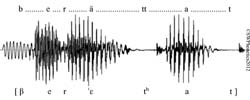
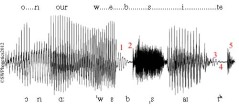
Praat tutorial: Speech waveforms
|
Listen to Purcell at 128kb/s:
Listen to Purcell at 192kb/s:
Unfortuntely, they sound the same. You can never be sure what sound quality web providers will broadcast your sounds at, or browsers reproduce them. These two sound files are different, but they both sound even more compressed, perhaps 96kb/s.
|
|
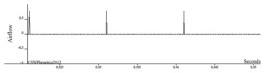
Four basic waveforms:
sine, triangle, sawtooth and pulse
played in that order
Listen and compare:
The sinewave has no overtones
The others have progressively stronger overtones:
|
| . |
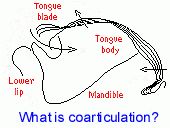 What coarticulation is about, with examples. Read more … What coarticulation is about, with examples. Read more …
|
 Speechwoman’s Speechwoman’s
SLP site of the month June 2011
Thank you Speechwoman
|
Caroline Bowen
wins award for the
Best educational site
 Posted 16 Dec 2012 Posted 16 Dec 2012
|


 Welcome to SWPhonetics